
Beyond the Neuro-Revolution: A Reflexive Commentary on Philosophy, Neuroscience, and the Mission of the Journal of NeuroPhilosophy
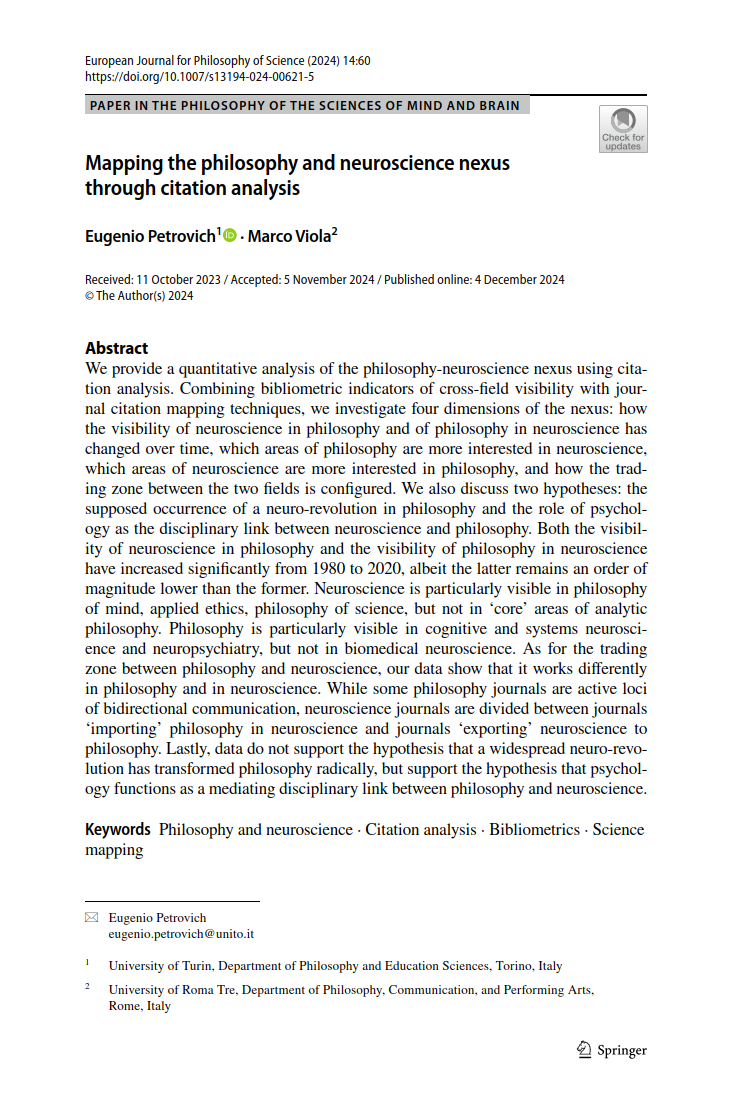
Comment on Petrovich, E., Viola, M. Mapping the philosophy and neuroscience nexus through citation analysis. Euro Jnl Phil Sci 2024;14:60 https://doi.org/10.1007/s13194-024-00621-5
The recent article by Eugenio Petrovich and Marco Viola offers the first large-scale scientometric mapping of the relationship between philosophy and neuroscience. Using citation analysis, the authors systematically examine the structure, intensity, and direction of interaction between these two disciplines over a period exceeding four decades. This work does not merely provide a quantitative description; it empirically challenges an intellectual narrative that has animated neurophilosophical discourse for decades: the idea that neuroscience has, or should have, fundamentally altered the practice and self-understanding of philosophy. Petrovich and Viola's meticulous citation analysis reveals a relationship that is robust but complex, uneven, and structurally asymmetric. Interpreted in the context of the broader aims of the Journal of NeuroPhilosophy (JNphi), their findings invite us not only to reassess past intellectual assumptions but also to reflect on the shape of the interdisciplinary frontier ahead. This essay aims to explore the methodological innovations of Petrovich and Viola's study, the philosophical and scientific implications of their findings, and how these findings intersect with the core mission of JNphi in an expanded, threefold framework.
JNphi's core mission is to foster rigorous interdisciplinary inquiry into age-old philosophical questions using the lens of neuroscience—to break free from disciplinary insularity while preserving conceptual depth. The journal strives to support conversations that range from the mind–body problem and consciousness to moral agency, emerging technologies, neuroethics, and the philosophical foundations of neuroscience itself. Its openness to diverse genres—reviews, perspectives, original research, and commentaries—reflects a commitment to pluralistic yet rigorous engagement with both empirical findings and conceptual analysis. The journal questions not only how neuroscientific data can transform philosophical concepts but also how philosophical analysis can illuminate the assumptions underlying neuroscientific research.
The Petrovich and Viola article aligns naturally with this mission. By providing empirical diagnostics of the philosophy–neuroscience interface, it places neurophilosophical inquiry on a more transparent and accountable empirical footing. This is precisely the kind of reflective "meta-perspective" that JNphi aims to cultivate: understanding not just what questions neuroscience and philosophy ask of each other, but how, where, and to what extent those exchanges are taking place. The study thus functions as an empirical foundation upon which the journal's editorial strategy and the broader field's self-understanding can be built.
The methodological rigor of the study deserves particular emphasis here. Petrovich and Viola operationalized philosophy and neuroscience using Web of Science (WoS) data, creating both "large" and "narrow" sets of journals. The "Philosophy large" set comprises 1,517 journals or book collections across four philosophy-relevant WoS categories ('Philosophy,' 'History & Philosophy of Science,' 'Ethics,' 'Medical Ethics'), while the "Neuroscience large" set includes 612 journals or book collections in two neuroscience categories ('Neurosciences,' 'Neuroimaging'). However, to ensure methodological soundness, the authors constructed "narrow" sets (Philosophy narrow and Neuroscience narrow) based on stringent criteria: journals must have published at least 300 research documents since 1980, received at least 500 citations to other WoS-indexed documents, and have at least 10% of their total citations pointing to other research documents in WoS. This careful selection addresses a critical challenge in bibliometric studies of philosophy: the field's heavy reliance on books and non-English language sources, which are poorly covered in WoS. As the authors note, only 32% of citations appearing in philosophy journals point to WoS-indexed publications, compared to 87% in neuroscience—a disparity that reflects philosophy's enduring engagement with books and monographs outside the database's scope.
The visibility indicators developed by Petrovich and Viola represent another methodological innovation. Their primary indicator, V_P (visibility of neuroscience in philosophy), measures for each philosophy journal the percentage of its research documents that cite at least one publication from neuroscience. Conversely, V_N measures for each neuroscience journal the percentage of its documents citing philosophy. Crucially, the authors also introduce inverse visibility indicators, capturing not how much a field cites the other, but how much it is cited by the other. This bidirectional approach reveals asymmetries that simple citation counts would obscure. For instance, a philosophy journal might extensively cite neuroscience (high visibility) without being cited back by neuroscientists (low inverse visibility), or vice versa. The authors' decision to measure visibility at the document level (whether an article cites at least one paper from the other field) rather than at the citation level (proportion of total citations) provides a robust measure of interdisciplinary engagement while minimizing the distorting effects of perfunctory or negative citations. As they argue, when aggregated across thousands of documents in hundreds of journals, these indicators offer reliable proxies for disciplinary communication patterns.
The construction of journal maps through bibliographic coupling further enhances the study's analytical power. By measuring the overlap in cited references between journals, Petrovich and Viola create visual representations of the internal structures of both philosophy and neuroscience. In these maps, journals that cite similar bodies of literature cluster together, revealing subdisciplinary formations without relying on pre-existing classifications. The philosophy map, based on 177 journals, reveals nine distinct clusters ranging from applied ethics to analytic philosophy, logic, philosophy of mind, and philosophy of science. The neuroscience map, covering 146 journals, shows five clusters organized along two axes: from basic to clinical research horizontally, and from whole-brain to molecular levels vertically. This bottom-up approach to disciplinary cartography allows the authors to locate precisely where interdisciplinary visibility concentrates—a significant advance over studies that treat disciplines as undifferentiated wholes.
2. Interdisciplinarity as Structural Landscape, Not Singular Revolution: The Gradual and Selective Integration of Neuroscience into PhilosophyA central insight of Petrovich and Viola's study is that the rise in neuroscience's visibility within philosophy over the past four decades, while real, is gradual rather than revolutionary. Philosophical engagement with neuroscience has grown steadily, but it remains deeply concentrated in certain subfields—especially philosophy of mind, philosophy of science, and applied ethics such as neuroethics—while core analytic domains like formal epistemology, metaphysics, and logic show comparatively little direct engagement with neuroscientific content. This pattern challenges the more maximalist narratives of neurophilosophical "revolution" that once dominated the field's self-understanding. Instead, what emerges is a picture of selective, domain-specific integration—a topology of intellectual connections that varies in intensity and directionality across disciplinary terrains.
The temporal analysis reveals striking trends. The visibility of neuroscience in philosophy remained stable at around 3% from 1980 to 2000, then increased linearly to 14.6% by 2023. This increase occurred despite a decrease in neuroscience's overall incidence in WoS after 2000, indicating that philosophers' growing attention to neuroscience reflects genuine intellectual interest rather than merely following broader publication trends. Similarly, the visibility of philosophy in neuroscience, though an order of magnitude smaller, increased from 0.4% to 1.5% over the same period. Both trends began their ascent around the turn of the century, suggesting a bidirectional intensification of cross-disciplinary attention.
However, this aggregate growth masks significant variation across philosophical subfields. The philosophy of mind cluster shows the highest average neuroscience visibility at 16.2%, with journals like Phenomenology and the Cognitive Sciences (61.1%), Journal of Consciousness Studies (52.4%), and Philosophical Psychology (50.8%) leading the way. The philosophy of science cluster follows at 13.6%, with neuroscience visibility distributed relatively evenly across its journals—suggesting that philosophy of neuroscience has become a recognized subdiscipline within philosophy of science. Applied ethics journals show high visibility only in dedicated venues like Neuroethics (75.7%), while most ethics journals show minimal engagement. The analytic philosophy cluster, home to prestigious journals like Mind, Nous, and The Philosophical Review, shows average visibility below 10%, indicating that core areas of analytic philosophy remain relatively insulated from neuroscientific influence.
For JNphi, whose mission is to bridge philosophy and neuroscience meaningfully and rigorously, this finding has important implications. It suggests that the journal's interdisciplinary portfolio—spanning theoretical work on cognition to ethical, epistemological, and technological intersections—is not merely an editorial preference but a structural necessity. The empirical landscape is not uniform; philosophical influence flourishes where conceptual questions resonate with neuroscientific frameworks. By embracing this heterogeneity, JNphi positions itself not as the advocate of a monolithic disciplinary merger, but as a facilitator of selective, high-impact intellectual intersections.
The contrast between the "salmon" and "owl of Minerva" metaphors proposed by the authors captures different modes of philosophical engagement. Philosophy of science's engagement with neuroscience resembles salmon swimming upstream—developing interest in epistemological issues arising from neuroscientific methods even as neuroscience's relative publication weight declines. Applied ethics, by contrast, may reflect an owl-like behavior, responding with some delay to ethical questions raised by neuroscientific advances. Philosophy of mind occupies an intermediate position, with high visibility suggesting active participation in theoretical debates such as those surrounding Karl Friston's free energy principle or the reverse inference controversy. These different temporal and functional patterns underscore the need for nuanced understanding of how philosophy engages with science—a complexity that JNphi's pluralistic approach is well-positioned to accommodate.
3. Asymmetry in Exchange: Philosophical Depth Meets Empirical ConstraintOne of the most striking findings is the asymmetry in citation flows: neuroscience appears more frequently in philosophy journals than philosophy does in neuroscience journals. Moreover, within neuroscience, philosophical visibility is disproportionately localized in cognitive and systems neuroscience and neuropsychiatry, with little presence in subfields such as molecular or cellular neuroscience, neurology, or neurosurgery.
This asymmetry is not merely a bibliometric curiosity; it maps onto deeper epistemological and methodological boundaries. Philosophers have adopted neuroscientific findings where these bear directly on questions of representation, cognition, and agency. Neuroscientists, by contrast, show restraint in citing philosophical work unless it directly informs conceptual frameworks or ethical reasoning. The trading zone between the two fields is thus selective and conditional.
The neuroscience journal map reveals this selectivity vividly. The red cluster (cognitive and systems neuroscience) shows average philosophy visibility of 1.8%, with journals like Integrative Psychological and Behavioral Science (37.6%), Cognitive Systems Research (21.9%), and Trends in Cognitive Sciences (12.4%) leading. The violet cluster (neuropsychiatry) follows at 1.1%. By contrast, the green cluster (molecular and cellular neuroscience), blue cluster (neurology and neurosurgery), and yellow cluster (neuropathology) all show average philosophy visibility below 0.5%—effectively zero in practical terms. Philosophy's impact on neuroscience is not merely small; it is concentrated in precisely those subfields that maintain close ties to psychology and cognitive science.
The analysis of inverse visibility—how much neuroscience journals are cited in philosophy—reinforces this pattern. The top 15 neuroscience journals most cited in philosophy include 13 from cognitive and systems neuroscience and two from neuropsychiatry. Trends in Cognitive Sciences leads with 55% of its publications cited in philosophy, followed by Nature Reviews Neuroscience at 44%. Both are review journals that synthesize broad areas of research, making them accessible to philosophical audiences. When normalized for cluster size, cognitive and systems neuroscience accounts for 52.7% of all neuroscience citations in philosophy despite producing only 25.3% of neuroscience publications—a 27.5 percentage point overrepresentation. Neuropsychiatry shows modest overrepresentation (+1.9 points), while molecular and cellular neuroscience is substantially underrepresented (-16.7 points). Philosophers' engagement with neuroscience is not merely skewed toward cognitive levels; it systematically neglects the biological foundations of brain function.
The trading zone configuration further illuminates this asymmetry. In philosophy, journals with high neuroscience visibility tend also to have high inverse visibility—they cite neuroscience and are cited back. Neuroethics, Journal of Consciousness Studies, and Phenomenology and the Cognitive Sciences exemplify this bidirectional pattern, functioning as active brokers of cross-disciplinary exchange. In neuroscience, by contrast, journals divide into two types: "axon-like" journals that cite philosophy without being cited back (high visibility, low inverse visibility), and "dendrite-like" journals that are cited by philosophy without citing it (low visibility, high inverse visibility). Cognitive Systems Research exemplifies the former, while Trends in Cognitive Sciences exemplifies the latter. This functional differentiation suggests that within neuroscience, the import of philosophical ideas and the export of neuroscientific findings occur through different channels—a structural feature that any interdisciplinary initiative must navigate.
JNphi's publication strategy rightly reflects this structural reality. By soliciting work that combines philosophical rigor with neuroscientific relevance, the journal does not merely amplify cross-citational visibility; it cultivates substantive engagement that addresses both conceptual coherence and empirical applicability. This dual commitment is crucial if neurophilosophy is to avoid becoming either a superficial borrowing of neuroscientific terms or a purely armchair reflection detached from empirical realities. The journal's emphasis on conceptual depth alongside empirical grounding positions it to bridge the asymmetrical relationship documented by Petrovich and Viola, fostering exchanges that are genuinely bidirectional rather than unidirectional flows from science to philosophy or vice versa.
4. Psychology as the Bridge, Not the Boundary: The Mediating Role of Cognitive ScienceThe article reinforces a longstanding observation: cognitive neuroscience and psychologically oriented subfields serve as the primary mediators of interactions between philosophy and neuroscience. This underscores the continued centrality of psychological theory and data in shaping philosophical engagements with the brain. Yet it also highlights a potential epistemic limitation: philosophical inquiry may risk aligning itself predominantly with domains where the conceptual and empirical interests naturally coincide, at the expense of less accessible but equally philosophically rich areas of brain science.
The evidence for psychology's mediating role is compelling. Philosophy's visibility in neuroscience concentrates in cognitive and systems neuroscience—the subfield most closely aligned with experimental psychology. Conversely, the neuroscience most visible in philosophy comes from the same subfield, along with review journals that synthesize psychological and cognitive research. The journals that function as bidirectional brokers—Philosophical Psychology, Phenomenology and the Cognitive Sciences, Journal of Consciousness Studies—explicitly position themselves at the intersection of philosophy and psychological science. Even the philosophical debates that trace their origins to neuroscience journals, such as those on cognitive ontology (stemming from Price and Friston in Cognitive Neuropsychology) and reverse inference (from Poldrack in Trends in Cognitive Sciences), address questions about the relationship between psychological constructs and neural measurements.
This psychological mediation has historical roots. As Petrovich and Viola note, the development of neuroimaging techniques in the 1990s brought neuroscience closer to psychology—a discipline with which philosophers were already familiar. The cognitive revolution of the 1960s had already established psychology, linguistics, artificial intelligence, anthropology, and neuroscience alongside philosophy as the cognitive sciences. Psychology thus functioned as a familiar bridge into the less familiar terrain of brain science. The subsequent development of cognitive neuroscience as a distinct field, integrating psychological theory with neural measurement, provided a natural meeting ground for philosophers interested in mind and cognition.
However, the concentration of philosophical attention on psychologically oriented neuroscience carries risks. Haueis has warned against "cognitive myopia"—interpreting all brain structures and processes in psychological terms while neglecting their biological functions. Before supporting cognition, the brain is a biological organ with its own cytology, histology, metabolism, and homeostatic regulation. Philosophical questions about reduction, emergence, and explanation might find different answers when examined at molecular or cellular levels than at cognitive systems levels. The nature of consciousness, for instance, might be illuminated by understanding the cellular mechanisms of consciousness, not just systems-level correlates. Questions about free will and moral responsibility might engage differently with neurosurgical interventions than with cognitive neuroimaging. Yet these connections remain largely unexplored, as Petrovich and Viola's data show.
JNphi's wide scope—embracing topics from the philosophy of consciousness to neuroethics, AI, and even socio-technical critiques of cognition—anticipates precisely this challenge. By inviting voices that traverse beyond cognitive paradigms into ethical, existential, and technological questions, the journal helps ensure that neurophilosophical discourse remains vibrant and expansive rather than narrowly tied to a single scientific subdomain. The journal's openness to diverse perspectives creates space for exploring the philosophical implications of molecular neuroscience, neurodevelopment, neuroimmunology, and other areas currently underrepresented in philosophy-neuroscience exchanges.
5. Editorial Mission as Public Forum and Critical Arena: The Role of Meta-Reflection in NeurophilosophyPetrovich and Viola's article prompts a meta-reflection that resonates deeply with the editorial mission of JNphi: neurophilosophical inquiry must be as much self-critical as it is interdisciplinary. As the journal continues to attract contributions that question the nature of consciousness, explore the ethics of emerging technologies, and examine the neural underpinnings of agency and cognition, it also becomes a forum for evaluating the contours of the field itself.
The historical narrative woven through Petrovich and Viola's introduction provides context for this self-critical stance. The trajectory from Patricia Churchland's revolutionary call to arms in Neurophilosophy (1986) through John Bickle's founding (and demise) of Brain and Mind journal to the current landscape of established subfields and dedicated venues illustrates the maturation of neurophilosophy from revolutionary aspiration to institutionalized reform. The "failed" revolution, as Bickle later characterized it, gave way to sustained, incremental integration—a pattern consistent with Petrovich and Viola's finding of gradual rather than abrupt increases in cross-disciplinary visibility. The very fact that Brain and Mind ceased publication after four years due to insufficient submissions, while later journals like Neuroscience of Consciousness (founded 2015) and Philosophy and the Mind Sciences (2020) have survived, suggests that the field has found its footing through patient institution-building rather than paradigm-shifting rupture.
This historical perspective underscores the importance of venues like JNphi that provide sustained support for interdisciplinary dialogue. The journal's role extends beyond publishing research to cultivating community, shaping discourse, and maintaining the institutional infrastructure that makes ongoing exchange possible. By providing a home for work that might otherwise fall between disciplinary cracks, JNphi contributes to the very processes that Petrovich and Viola measure—the increasing visibility that signals genuine intellectual connection.
By providing empirical maps of intellectual exchange, studies like the one under review invite the neurophilosophical community to think not only about the content of interdisciplinary dialogue but its structure and dynamics. Such reflexivity is essential—not merely to chart where philosophy and neuroscience have been in conversation, but to guide where they might productively go next. Questions arise: Should philosophers seek greater engagement with molecular and cellular neuroscience, or is the current concentration on cognitive levels appropriate given philosophical interests? How can the asymmetry in citation flows be addressed without demanding that neuroscientists cite philosophy for reasons external to their research? What forms of writing and publication might facilitate more bidirectional exchange?
JNphi's commitment to diverse genres—original research, reviews, perspectives, commentaries—provides a laboratory for experimenting with these questions. Original research articles demonstrate how philosophical analysis can contribute to neuroscientific debates. Reviews synthesize bodies of work for interdisciplinary audiences. Perspectives offer speculative explorations of emerging issues. Commentaries create space for dialogue and critique. This generic pluralism reflects an understanding that different modes of writing serve different functions in interdisciplinary communication—a point that Petrovich and Viola's finding about the special role of review journals in philosophy-neuroscience exchange reinforces.
6. The Path Ahead: From Descriptive Cartography to Generative DialogueThe contribution of Petrovich and Viola does not offer a terminus to debate; rather, it lays the groundwork for more nuanced and context-sensitive questions. How might philosophical inquiry inform neuroscientific experimental design? In what ways can ethical analysis shape policy related to neurotechnology? How can neuroscience deepen philosophical understanding without subsuming it? These are precisely the kinds of generative questions that sit at the heart of JNphi's mission and editorial direction.
The study's limitations, thoughtfully acknowledged by the authors, point toward future research directions. The journal-level analysis, while appropriate for mapping disciplinary structures, cannot capture individual researchers who publish across fields—philosophers publishing in neuroscience journals or neuroscientists publishing in philosophy journals. A complementary author-level analysis might reveal different patterns of exchange, perhaps showing more bidirectional engagement than journal-level data suggest. Similarly, the focus on citations as traces of communication cannot distinguish between different functions of citations—conceptual borrowing, critical engagement, perfunctory acknowledgment—though the authors' document-level approach mitigates some concerns about perfunctory citations. Content-based approaches, such as topic modeling of full texts, could complement citation analysis by revealing what philosophers and neuroscientists actually say about each other's work.
The study's temporal scope, extending to 2023, captures trends up to the present but cannot predict future directions. Will the visibility increases continue linearly, plateau, or accelerate? Will emerging fields like computational psychiatry, social neuroscience, or neuroeconomics create new points of contact? Will artificial intelligence, with its own philosophical implications and neuroscientific connections, reshape the landscape? These questions await future research, which Petrovich and Viola's methodological framework equips us to pursue.
For JNphi, the study offers both validation and direction. Validation, because the journal's commitment to fostering substantive interdisciplinary exchange aligns with the empirical patterns of successful engagement documented in the study. Direction, because the asymmetries and concentrations revealed by the analysis suggest opportunities for expansion. The journal might actively cultivate submissions from underrepresented areas—molecular neuroscience, neurodevelopment, neuroimmunology—while maintaining its strength in cognitive and ethical domains. It might encourage submissions that experiment with forms of writing optimized for bidirectional exchange, learning from the success of review journals in reaching philosophical audiences. It might sponsor meta-analytical work that continues the cartographic project Petrovich and Viola have initiated, tracking how the landscape evolves over time.
As the Journal of NeuroPhilosophy continues to publish work that spans methodological divides and conceptual traditions, the community benefits not just from empirical knowledge but from critical reflection on the very processes of interdisciplinary knowledge production. In this light, the measured and multifaceted account offered by Petrovich and Viola becomes not an endpoint but an invitation—an invitation to deepen the dialogue, refine the questions, and expand the intellectual spaces where philosophy and neuroscience meet. The anatomy of interdisciplinarity they have mapped provides our generation of neurophilosophers with a clearer sense of where we stand and, more importantly, of the paths that lie open before us.
Petrovich, E., Viola, M. Mapping the philosophy and neuroscience nexus through citation analysis. Euro Jnl Phil Sci 2024;14:60 https://doi.org/10.1007/s13194-024-00621-5


